
TANGERANG – Industry leaders and global experts have asserted that world-class geological potential is not enough to secure large-scale international investment in Indonesia. The government and business players must synergize to address "above-ground risks" by aligning overlapping cross-sectoral policies and increasing the certainty of permit timelines. This step is crucial to turning giant reserve discoveries into tangible national production.
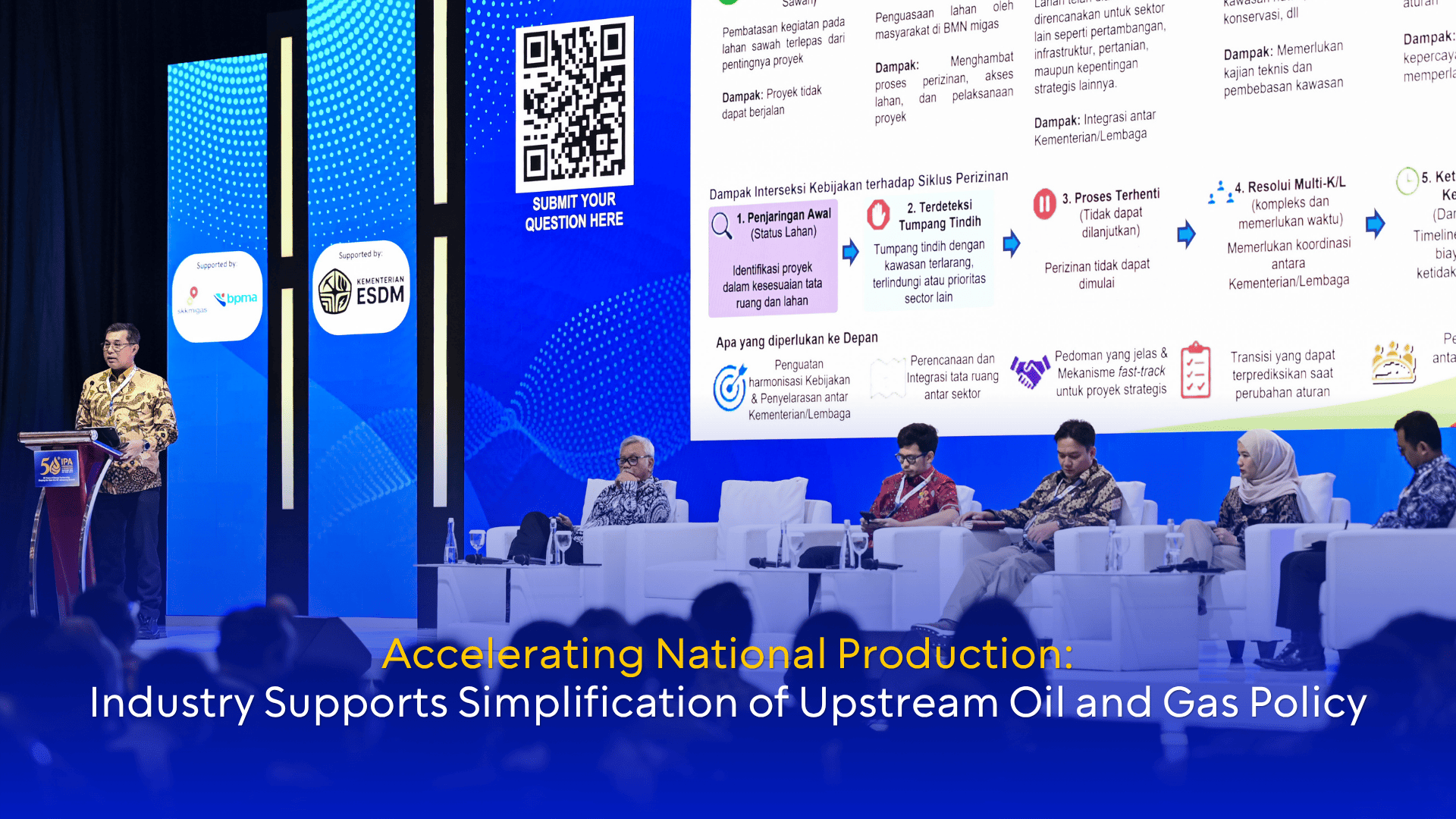
This imperative became the primary focus of a high-level plenary session titled “Policy Simplification and Ease of Doing Business: Progress, Challenges, and the Road Ahead” at the 50th IPA Convention and Exhibition (IPA Convex 2026). The session brought together state regulators, legal academics, and global analysts to formulate a concrete legislative roadmap for the national energy sector.
This alignment effort is urgent because Indonesia still faces a crude oil deficit in meeting its national energy needs. On the other hand, investment commitments in the upstream oil and gas sector are massive, with a target of reaching 18.87 billion USD in 2026, which is projected to contribute approximately 10 billion USD to state revenue.
The discussion session opened with a fundamental legal analysis by Didik Sasono Setyadi, an independent consultant. Didik assessed that systemic bottlenecks in project completion occur because upstream oil and gas activities are currently treated the same as ordinary commercial businesses in the field.
Based on Article 33 of the 1945 Constitution, the government holds a dual mandate: the authority of representation in the management of natural resources, as well as control over vital and strategic branches of production. Three main legal pillars reinforce this constitutional mandate: the Oil and Gas Law, the Spatial Planning Law, and the State Treasury Law.
"Existing laws provide a forceful message that oil and gas must be prioritized in national spatial planning because of their status as vital and strategic state assets," said Didik.
Didik pointed out a legal paradox in field practice: international investors must bear the administrative burden of handling permits from various ministries separately. Proper governance logic suggests that the government should prepare all licensing, spatial allocation, and land acquisition matters internally before handing them over to operators.
To achieve this, he proposed structural changes through a "One-Door" model under the Ministry of Energy and Mineral Resources (ESDM). Through this framework, the PSC Contractors (KKKS) would only need to submit their Work Program and Budget (WP&B) to SKK Migas, while the Ministry of ESDM would act as the sole leading sector, resolving all environmental, forestry, and agrarian approvals internally within the government.
Representing the regulatory front line, Eka Bhayu Setta, Deputy of Business Support at SKK Migas, provided a pragmatic view of operational conditions. Bhayu clarified that project delays are multi-layered issues, triggered not only by bureaucracy but also by the readiness level of engineering designs from the operator's side. "Project acceleration is achieved through readiness, not shortcuts," asserted Bhayu.
Bhayu explained that SKK Migas has transformed toward an "engineering-led permitting" approach, which assesses document maturity through strict Permit Readiness Index (PRI) parameters. SKK Migas has also integrated the Investment Coordinating Board’s (BKPM) Online Single Submission Risk-Based Assessment (OSS RBA) system with the Ministry of Environment and Forestry’s AMDALNET. This integration has resulted in clear Service Level Agreements (SLAs): 15 working days for UKL-UPL completion and 50 working days for AMDAL approval.
Bhayu did not deny that projects in the field often still face obstacles due to the intersection of policies between ministries. These critical overlaps include the moratorium on Protected Paddy Land (LSD), land encroachment by communities on upstream oil and gas State-Owned Assets (BMN), and spatial conflicts with the mining, coal, and forestry sectors. These cross-sectoral deadlocks often freeze the permit cycle before the AMDAL study even begins.
"What is urgently needed by the upstream oil and gas sector right now to move from mere paper approvals to real project resolution is total policy alignment, spatial certainty, and a specific fast-track mechanism for national strategic projects," Bhayu concluded.
Responding to these challenges, Giri Ahmad Taufik, Director of Article 33, noted that these multi-layered bottlenecks are a consequence of the fragmented administration of state institutions. Taufik observed that although the Ministry of ESDM is naturally the patron of the upstream oil and gas sector, it does not yet have binding legal authority to compel other ministries to align their spatial regulations. The industry requires a permanent solution through the issuance of a Special Government Regulation (PP) that legally mandates interministerial integration for national strategic energy assets.
The government's perspective, presented by Ariana Soemanto, Director of Upstream Oil and Gas Business Development at the Ministry of ESDM, showed that the state has taken tangible steps in regulatory simplification. The Ministry of ESDM has radically slashed approximately 340 layered permits down to only two core regulatory points at the ministerial level. The government also introduced flexibility in fiscal provisions, giving investors the freedom to choose between the Cost Recovery scheme or a new, simpler Gross Split scheme, with production sharing offers reaching 95% for nonconventional gas to maximize project economics.
Hanna Othman, Associate Director of E&P Terms and Above Ground Risk at S&P Global, provided a regional benchmark analysis to view Indonesia's competitiveness in the global landscape. Hanna revealed that international capital is highly sensitive to fiscal stability and administrative efficiency. Above-ground risk factors play a role just as important as subsurface geological conditions.
S&P Global’s quantitative framework assesses a country's competitiveness through key pillars, including civil society risk, state bureaucratic efficacy, and macroeconomic strength. In the energy sector, investor decisions are dictated by the clarity of the legal framework, the competitiveness of fiscal provisions, and the efficiency of the permitting bureaucracy.
Neighboring jurisdictions like Malaysia are considered successful in maintaining global investor confidence in the long term because they utilize PETRONAS as a centralized entity with full authority as a true "one-stop shop" for both commercial and regulatory alignment, ensuring very high timeline certainty for industry players.
As the discussions at IPA Convex 2026 proceeded, a clear and constructive consensus emerged among the panelists. Indonesia's geological quality is acknowledged as world-class, and the relevant ministries are continuously innovating. Converting natural wealth into real national production requires the state to focus on bridging bureaucratic silos between ministries so that the licensing process can transform into a single integrated national machine that guarantees absolute certainty for global energy investors. (*)