

TANGERANG — As the Indonesian Petroleum Association (IPA) Convention and Exhibition (Convex) 2026 officially kicked off Wednesday, 20 May 2026, in ICE BSD City, the spotlight firmly landed on a critical industry imperative: accelerating project delivery times without compromising safety, quality, or budget.
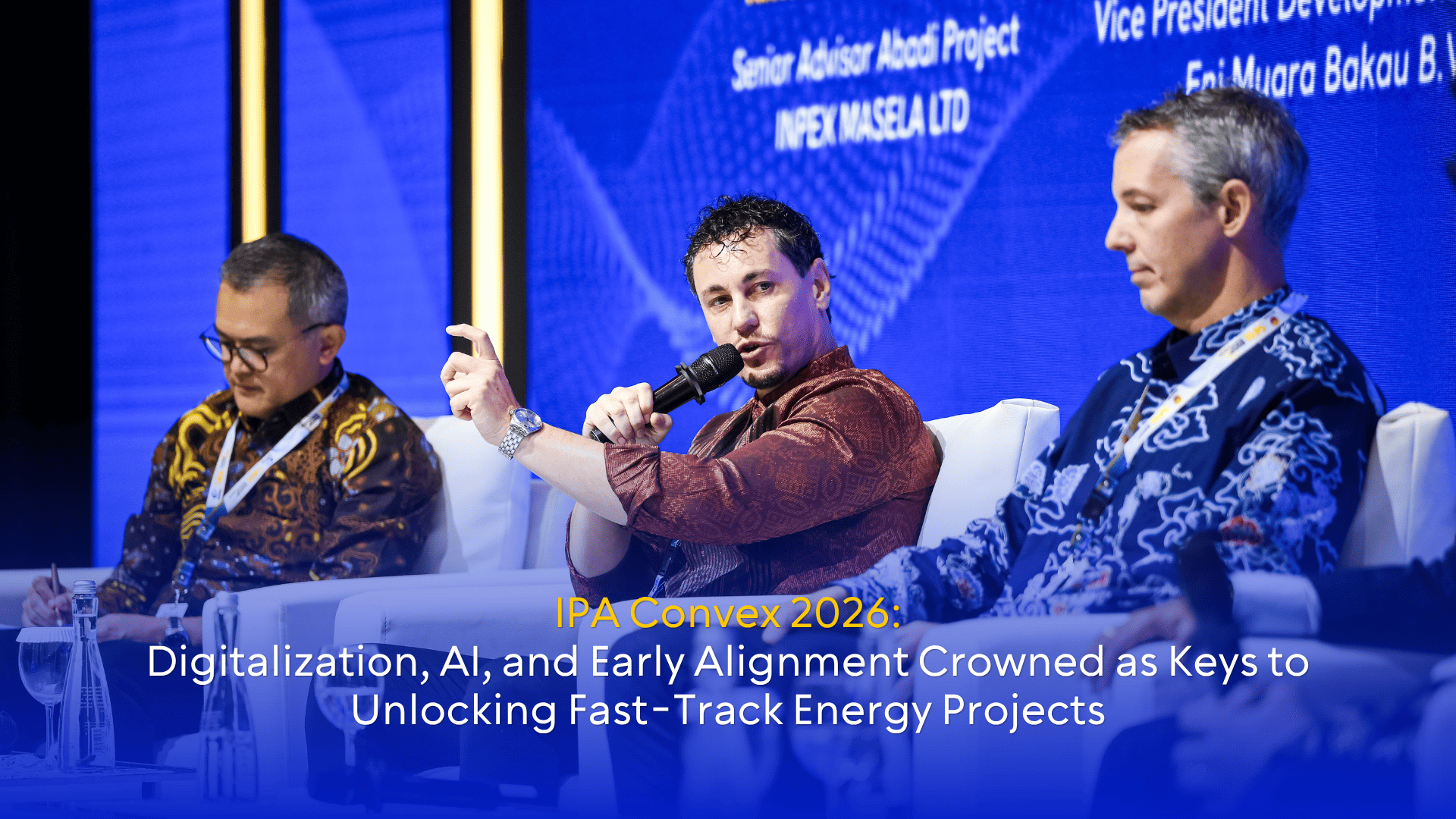
In a high-level plenary session called "Technology-driven Innovation for Advancing Project Development," they explore global benchmarks and contractor synergies. Industry leaders revealed that the traditional boundaries of the oil and gas sector are being fundamentally rewritten by artificial intelligence (AI), massive computing power, and a drastic shift toward strategic collaboration.
The panel opened with a crucial reality check for the upstream sector: project delays rarely stem from pure engineering hurdles. Instead, they are deeply rooted in fragmented organizational alignment and sluggish internal governance.
"An accelerated project needs clear priorities and fast decision-making," noted Simone Belli, VP of development projects at Eni Maura Bakau, as one of the operator representatives on the panel. "You know very often delays do not come from the technical complexity, but rather from either fragmented alignment or a slow approval process."
Belli challenged the conventional wisdom that speed is achieved purely during the construction phase. We tend to think that to go fast we have to optimize the execution phase, but to me, that's just the last piece of the mile. Everything starts from the beginning. The day after we make a valuable discovery, then the clock starts ticking."
Contractors echoed this sentiment, stressing that locking in engineering, procurement, and interface management early in the process, especially in complex deepwater and subsea environments, is what creates absolute certainty for an asset's timeline.
AI and Supercomputing: From "Buzzword" to Operational Reality
The conversation quickly turned to the role of advanced technology, with the panel evaluating whether artificial intelligence and digital workflows are delivering genuine value or simply generating industry buzz.
According to global operators, the impact of AI is no longer a future projection; it is actively reshaping modern workflows. The deployment of historic industrial computing power has been the ultimate differentiator for global energy major Eni. Simone Belli shared a striking example of how mega-data processing is directly shrinking the time-to-market window:
Simone Belli says, “This gives us the opportunity to improve the exploration accuracies, the operational performances, and the time to value across all the global projects." However, the panel emphasized that AI cannot unlock capital efficiency if it operates in a vacuum.
"I really believe... that digital innovation creates value when it's fully integrated into an agile execution environment and a fast decision-making environment, not when it operates as a standard of leadership," Simone added.
Meanwhile, operators managing sprawling global portfolios highlighted how digital infrastructure keeps execution seamless across multiple continents. Representative Haritki noted that digitalization allows teams to work 24 hours a day across shifting time zones. Looking ahead, the next frontier for AI lies squarely in production assets.
"In terms of the AI, we anticipate and expect its maximum contribution during the operation phase for the production of digitalization and for the predictive maintenance," Biswdeep Das, vice president of operations at McDermott International, stated.
The Power of Standardization and Elimination
Chris Ratajczak, Vice President of APAC Subsea 7, pointed out that the truest form of innovation often involves simplifying rather than complicating. He pointed to a portfolio approach in Brazil where four massive deepwater projects are using identical hardware and pipeline designs to radically cut down risk and schedule times.
Furthermore, digital engineering alone has driven engineering efficiency up by at least 30% compared to just five years ago. "But the ultimate benefit of technology is elimination," Chris Ratajczak, vice president of APAC Subsea7, argued. "If you can use technology to eliminate that, that's a big change in terms of complexity... long-distance tiebacks where we can actually eliminate a host, and then you have a magnitude of cost savings."
Chris cited the Sakarya project in Turkey as a prime example of what happens when rapid decision-making and standard designs are seamlessly integrated, noting the project achieved an astonishing 30 months from discovery to first gas.
That's a 10-well development with a gas plant that is 2,000 meters long. Everything was perfect. But the only way we achieved that was through alignment from the top and alignment in decision-making. So we were placing awards on the procurement before we actually placed the award on our main contracts. So the approval process was very fast," Chris detailed.
The ultimate focal point of the session was translating these global tech breakthroughs into the Indonesian context, where complex regulatory frameworks and bold government targets are shaping the future of Minyak dan Gas.
Panels noted that Indonesia's pipeline of upcoming projects, including at least three expected Floating Production Storage and Offloading (FPSO) vessels in the coming years, presents a prime canvas for digitalization, modular construction, and local capacity building.
However, fast-tracking Indonesian projects requires navigating remote project geographies and strict state mandates. Industry speakers stressed that operators are actively aligning with state regulators to expedite energy production.
"We are responding to the government's clear direction for the delivery and bringing the project on stream as early as possible," Rifkiandi Dorajatun, senior advisor of the Abadi Project, INPEX Masela LTD., said. "So, we are working closely with the contractors who engaged at the beginning to find the best solution for the project execution," he stated.
Achieving this national acceleration requires a careful compromise between trying new digital methodologies and maintaining strict project governance. "Nevertheless, we think that we need to strike a balance between fostering innovation and the discipline of the project execution to have the most efficient and the best capability we can deliver," he added.
As IPA Convex 2026 continues through May 22, the message from the industry is unmistakable: the technology to radically cut project timelines and costs exists today. To unlock it for Indonesia's energy security, operators, contractors, and regulators must work together closely. (*)