
TANGERANG– Both the government and Production Sharing Contract (PSC) contractors are intensifying efforts to accelerate national oil and gas production. One of the latest initiatives introduced by SKK Migas, dubbed the “Triple 100” program, is expected to help address mounting concerns over the significant challenges in achieving this year’s production targets and sustaining output growth in the years ahead.
Rikky Rahmat Firdaus, Deputy for Exploration, Development and Working Area Management at SKK Migas, explained that the Triple 100 initiative was designed to fill the production gap caused by the absence of major upstream projects coming onstream this year. In contrast, last year’s output was supported by large-scale projects such as Terubuk, Forel, and the Infill Clastic Drilling program in Cepu, which significantly contributed to national oil production.
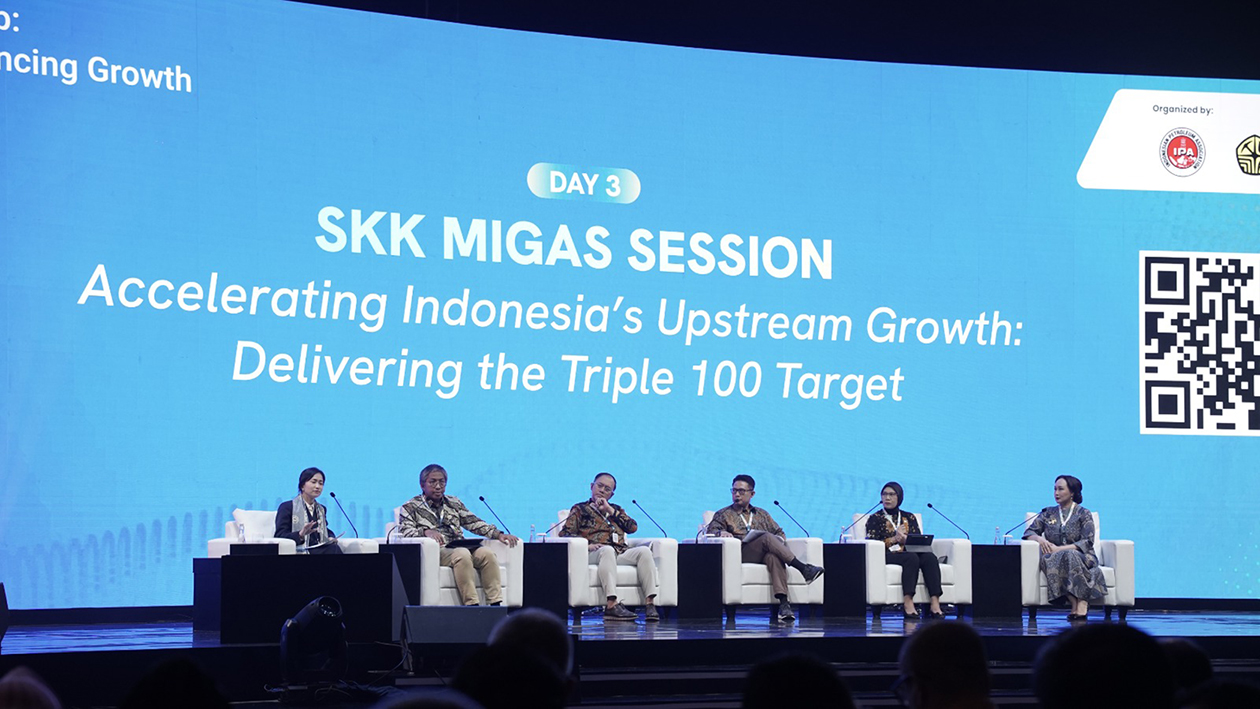
“Mr. Djoko Siswanto expressed concerns that in 2026 we would no longer have major projects of that scale. At that point, our leadership instructed us to launch the Triple 100 program, consisting of 100 exploration wells, 100 multi-stage and multi-layer fracturing initiatives, and 100 additional development wells from exploration discoveries to be developed within the next two to three years,” Rikky said on the sidelines of the SKK Migas Session – Accelerating Indonesia’s Upstream Growth: Delivering the Triple 100 Target at IPA Convex 2026 held at ICE BSD on Friday (22/5/2026).
According to Rikky, between January and March this year, SKK Migas had already identified 63 exploration initiatives, 53 multi-stage fracturing initiatives, and 52 additional development wells that could potentially be executed by PSC contractors. He acknowledged that these programs had not been included in the original work program and budget discussions conducted in October and November last year, making them additional initiatives outside previously approved plans.
From a technical perspective, Rikky admitted the program would not be easy to implement, particularly given the limited preparation time.
“There are challenges related to permitting, procurement, and various other aspects that were not planned as thoroughly as last year’s programs. All of these processes are still ongoing,” he said.
Based on SKK Migas data, five exploration wells have already been drilled under the exploration component of the program. In the multi-stage fracturing segment, two wells have been completed in the Rokan area. Meanwhile, two development wells near exploration areas have also been realized. Out of the target of 832 development wells, 175 wells have been completed so far.
Meanwhile, Mery Luciawaty, Director of Development and Production at PT Pertamina Hulu Energi (PHE), stated that technically the Triple 100 program is not entirely new for Pertamina, which drills more than 800 wells annually. However, she emphasized that PHE would place a strong focus on fracturing activities.
“Pertamina’s fracturing activities have grown by more than 40 percent over the past five years. This year alone, we are carrying out more than 200 fracturing activities, including 13 to 16 multi-stage fracturing operations,” Mery explained.
She also acknowledged that a range of challenges continue to hamper the execution of drilling programs, including the Triple 100 initiative, particularly in relation to permitting and land acquisition.
“Various advocacy efforts have been carried out together with ministries, SKK Migas, and the Ministry of Energy and Mineral Resources, but many obstacles still need to be resolved,” Mery said.
In addition, PHE must ensure the availability of fracturing units, water supply, waste management systems, and supporting ecosystems. For that reason, the company continues to collaborate closely with regulators and technology providers.
Overall, Mery noted that the biggest challenge facing the Triple 100 program lies in project economics, as reserves are becoming smaller while operational costs continue to rise, even as projects must still meet corporate investment thresholds.
“Therefore, we need regulatory support and fiscal incentives from the government. Most importantly, we require support from technology providers to close the technology gap and build a reliable supporting service ecosystem,” she concluded.