

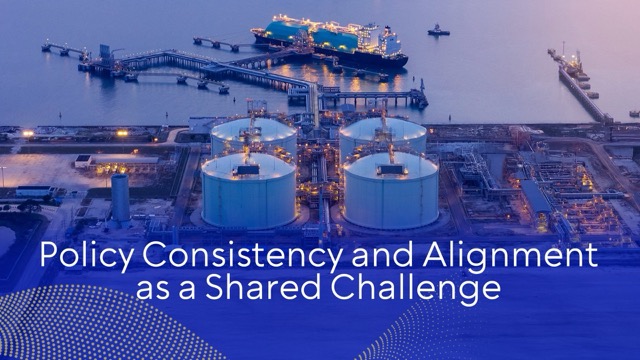
In the discourse on national energy governance, the upstream oil and gas sector occupies a strategic position that is inseparable from the agenda of energy security and long-term economic development. Unlike other sectors that can respond to policy changes within relatively short time horizons, the upstream oil and gas industry operates on long cycles, from exploration and development to production, which may span decades. This characteristic makes policy consistency and alignment a fundamental prerequisite for investment sustainability and sound business planning.
In practice, energy and industrial policies exist within a dynamic landscape. Shifts in national priorities, regulatory adjustments, and differing mandates across ministries and institutions are part of the reality of governing strategic sectors. These dynamics are unavoidable, yet they demand strong coordination mechanisms to ensure that medium- and long-term policy direction remains intact. Without policy continuity, the upstream oil and gas sector risks facing uncertainty that directly affects investment appetite and the sustainability of national production.
Maintaining Certainty in a Dynamic Policy Landscape
According to Didik Sasono Setyadi, Chairman of the Indonesian Association of Oil, Gas, and Renewable Energy Legal Practitioners (APHMET), the main challenge in managing the upstream oil and gas sector lies in the mismatch between the industry’s long-term nature and relatively shorter policy cycles. “The upstream oil and gas industry operates within a long time frame. From exploration to production can take many years, even decades, while policies are often formulated over much shorter periods,” he said.
Didik explained that energy sector policies frequently involve multiple institutions with differing authorities and perspectives. In this context, cross-sector policy alignment becomes critical to ensure that resulting regulations do not overlap or create new uncertainties for industry players. He emphasized that coordination among ministries and agencies should be viewed as part of a collective effort to safeguard national energy security, rather than merely as an administrative process.
Furthermore, Didik noted that the upstream oil and gas sector is often positioned primarily as a source of state revenue, while its strategic role as a foundation of energy security has not been fully reflected in the policy framework. This approach can influence regulatory direction, particularly when fiscal and non-fiscal policies are formulated without adequate consideration of business cycles and the high risks inherent in oil and gas exploration and production activities. “If upstream oil and gas is viewed solely from the perspective of state revenue, the resulting policies tend to be short-term oriented, even though this sector is the foundation of long-term energy security,” Didik said.
In his view, a sound legal and regulatory framework does more than provide legal certainty. It also serves as a policy signal to investors. Such certainty encompasses regulatory consistency, clarity in licensing processes, and alignment between central policies and their implementation on the ground. When policy signals change too frequently or lack alignment across sectors, businesses tend to delay investment decisions, which ultimately affects upstream activity levels and national production. “What industry players truly need is certainty. As long as policy direction is clear and consistent, the industry can plan more rationally,” he explained.
It is within this context that strengthening policy coordination mechanisms becomes a shared necessity. Didik emphasized that cross-sector policy alignment does not mean harmonizing all interests, but rather ensuring that each policy moves within the same national objective framework. This approach is essential to maintaining balance between state interests, industry sustainability, and long-term national energy needs.
In line with this perspective, the Indonesian Petroleum Association (IPA), as a collaborative partner of the government within the national energy ecosystem, plays a role in supporting regulators in formulating policies that are better aligned with the characteristics and challenges of the upstream oil and gas sector.
Collaboration among the government, industry associations, and other stakeholders is key to building a policy framework that is consistent, coordinated, and predictable. Within an evolving policy landscape, open and continuous dialogue is required to ensure that policy adjustments remain within the corridor of long-term national energy security objectives.
These perspectives underscore that the sustainability of the upstream oil and gas sector is not the responsibility of a single party, but rather the outcome of well-managed policy synergy. Policy consistency and alignment, therefore, constitute a strategic foundation for ensuring that the upstream oil and gas sector can continue to contribute optimally to national energy security and the broader economy.